


Or is integration complexity holding back your AI ambitions?
By Susanne Møllegaard, CEO, Process Factory
Many leadership teams are currently asking how they can extract more value from AI. It is an important question. Perhaps, however, the question should be broadened: How much of your AI investment is actually being spent overcoming legacy dependencies within your system landscape?
As AI tools become increasingly accessible, the source of competitive advantage is changing. Success will not be determined solely by access to AI technology, but by an organisation’s ability to transform its own data into better decisions, stronger processes and scalable AI solutions.
This is why AI-ready data should form an integral part of business strategy. All indications suggest that the next stage of AI competition within the insurance industry will be decided here.
The good news is that moving forward does not necessarily require another major integration programme. With Integration as a Service, insurers can reduce integration complexity, strengthen their data capabilities and allow internal teams to focus on what truly creates business value: improving customer experiences, accelerating claims handling, strengthening compliance and delivering AI solutions that can scale with the business.
AI is now firmly on the agenda of most insurance companies. The conversation has moved beyond whether AI should be adopted to how organisations can realise business value more quickly and with greater confidence.
Yet one challenge continues to emerge time and again. Companies invest millions in AI initiatives while the underlying data remains trapped within IT landscapes built over the past 10, 15 or even 20 years.
The result is more costly AI programmes, longer implementation timelines and business cases that become increasingly difficult to justify. At the same time, highly skilled specialists spend valuable time locating, validating and preparing data rather than developing solutions that create measurable business value. AI delivers value through data, decision logic, business processes and integrations. When data is fragmented, outdated, difficult to access or constrained by complex integration landscapes, AI tends to amplify existing limitations rather than unlock new opportunities.
This is where many AI strategies meet reality.
60% of AI Projects unsupported by AI-Ready data will be abandoned
Gartner reports that 63% of organisations either lack, or are uncertain whether they possess, the right data management practices for AI. Gartner further predicts that by 2026, organisations will abandon 60% of AI projects that are not supported by AI-ready data.
It is an important reminder that AI-ready data is not merely a technical concern. It is a strategic prerequisite for realising the value of AI.
When Integration Complexity Becomes a Barrier to Growth
For the insurance industry, this issue is particularly relevant. Over decades, many insurers have modernised in layers. New core systems. New customer platforms. New partners. New regulatory requirements. New external data sources. Each investment has delivered value in isolation. Collectively, however, they have frequently resulted in complex integration landscapes where change becomes unnecessarily slow, costly and difficult.
This does not necessarily mean that existing integrations are failing. Many perform perfectly well in day-to-day operations. The challenge arises when the business needs to evolve faster than the integration landscape allows. When connecting a new data source takes months rather than weeks. When specialists spend their time finding, validating and consolidating data. When AI teams must compensate for technical debt before they can begin creating new value.
At that point, integration stops being an IT concern and becomes a strategic constraint on growth.
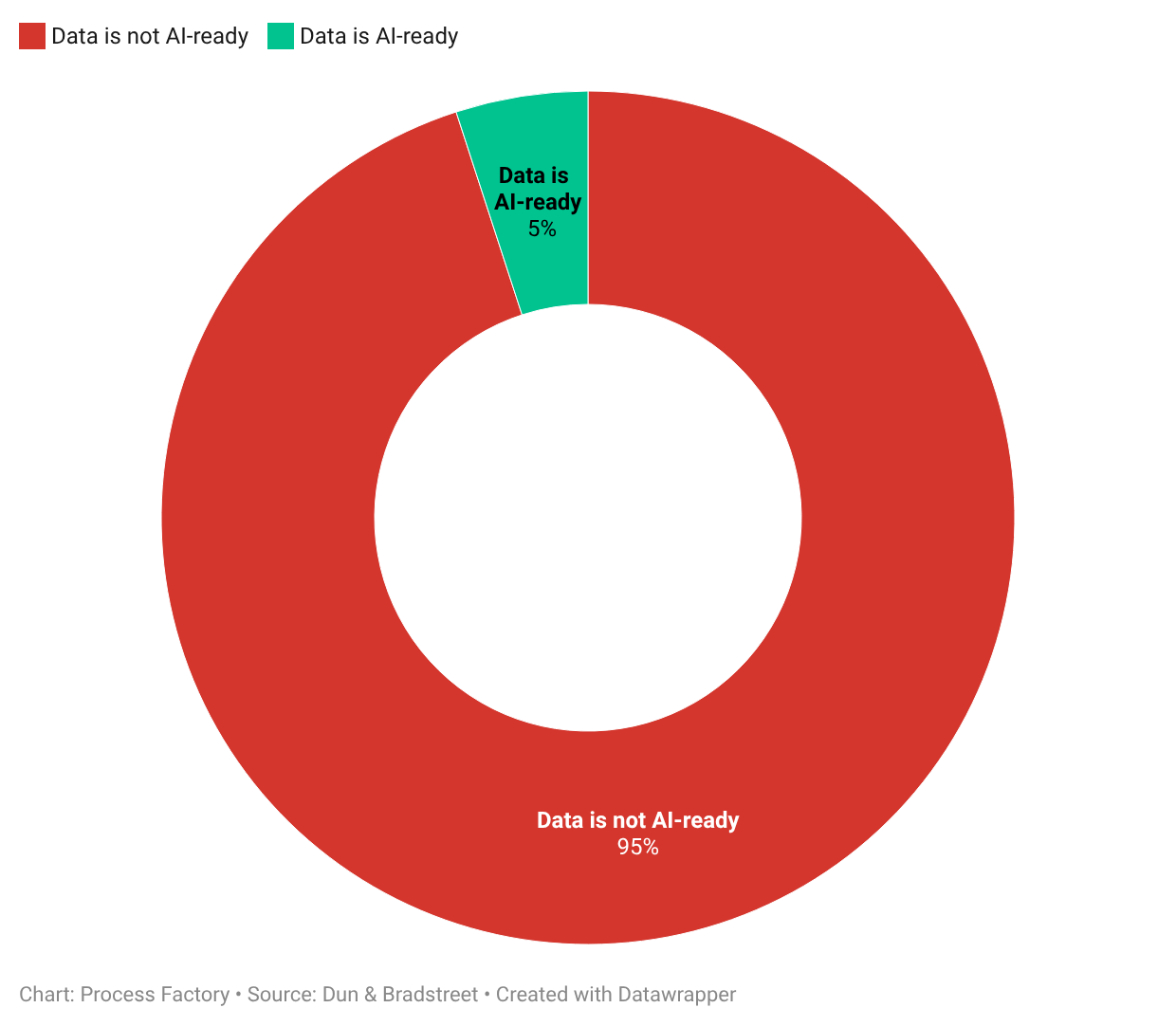
A global survey conducted by Dun & Bradstreet among 10,000 organisations found that 97% are actively pursuing AI initiatives, yet only 5% believe their data is sufficiently prepared to support them. Half of respondents identified limited access to data as their biggest obstacle, while 38% cited inadequate integration between systems.
The imbalance is clear: AI adoption is accelerating, while the underlying data foundation continues to lag behind.
The traditional expression “garbage in, garbage out” no longer fully captures the challenge. In an AI context, poor data quality can become automated risk.
This goes far beyond an inconvenience for analysts or an operational efficiency issue. When AI supports decision-making, automation or customer-facing processes, weaknesses in the underlying data can spread faster, wider and with potentially greater consequences.
IBM reports that more than a quarter of organisations estimate they lose over $5 million annually due to poor data quality, while 7% report losses exceeding $25 million per year.
When data quality issues intersect with AI, the consequences extend well beyond financial impact. They affect trust, compliance, governance, accountability and regulatory defensibility.
AI-Ready Data Requires Strategic Action
AI-ready data should be viewed as a strategic capability, developed and governed in the same way as any other business-critical capability. The objective is to create a data foundation that enables organisations to realise AI value faster and at scale, while ensuring data can be used securely, consistently and flexibly across systems, processes and partners.
In other words: AI-ready data depends on flexible integration capabilities.
Flexible integration capabilities allow organisations to connect new data sources, adapt existing data flows, onboard new partners and respond to changing business requirements without creating additional dependencies every time change is required.
This is where technology becomes strategically important. When data can be used effectively across the organisation, it strengthens innovation, improves decision-making and enables AI to scale without accumulating additional technical debt.
Integration as a Service: The Route to AI-Ready Data
Many organisations still view integrations as isolated development projects. Something to be commissioned, built, tested and maintained. That approach is increasingly unsuited to a world where AI, automation, regulatory change and new partnerships continuously reshape business requirements. Integrations should increasingly be managed as a service, much as organisations came to view cloud not merely as a technology platform, but as a strategic enabler of business agility.
When the integration layer is managed as a service, organisations gain a flexible infrastructure that allows data to be made available wherever the business needs it, without complexity increasing at the same pace. This enables internal specialists to focus on the activities that genuinely create competitive advantage: New services, better decision support, more effective automation and faster conversion of AI into business value.
At Process Factory, Integration as a Service is specifically designed to reduce the complexity surrounding data exchange, enabling insurance companies to focus their internal capabilities on value creation rather than integration maintenance.
How Much of Your AI Investment Is Actually Compensating for Integration Complexity?
Many leadership teams are currently asking how they can extract more value from AI. It is an important question. Perhaps, however, the question should be broadened: How much of your AI investment is actually being spent overcoming legacy dependencies within your system landscape?
As AI tools become increasingly accessible, the source of competitive advantage is changing. Success will not be determined solely by access to AI technology, but by an organisation’s ability to transform its own data into better decisions, stronger processes and scalable AI solutions.
This is why AI-ready data should form an integral part of business strategy. All indications suggest that the next stage of AI competition within the insurance industry will be decided here.
The good news is that moving forward does not necessarily require another major integration programme. With Integration as a Service, insurers can reduce integration complexity, strengthen their data capabilities and allow internal teams to focus on what truly creates business value: improving customer experiences, accelerating claims handling, strengthening compliance and delivering AI solutions that can scale with the business.